

Author: expert Ella Pill
Instagram: @ella_permanentmakeup
21 years in the beauty industry. An expert in permanent makeup for Eyebrows, Lips, and Eyeliner.
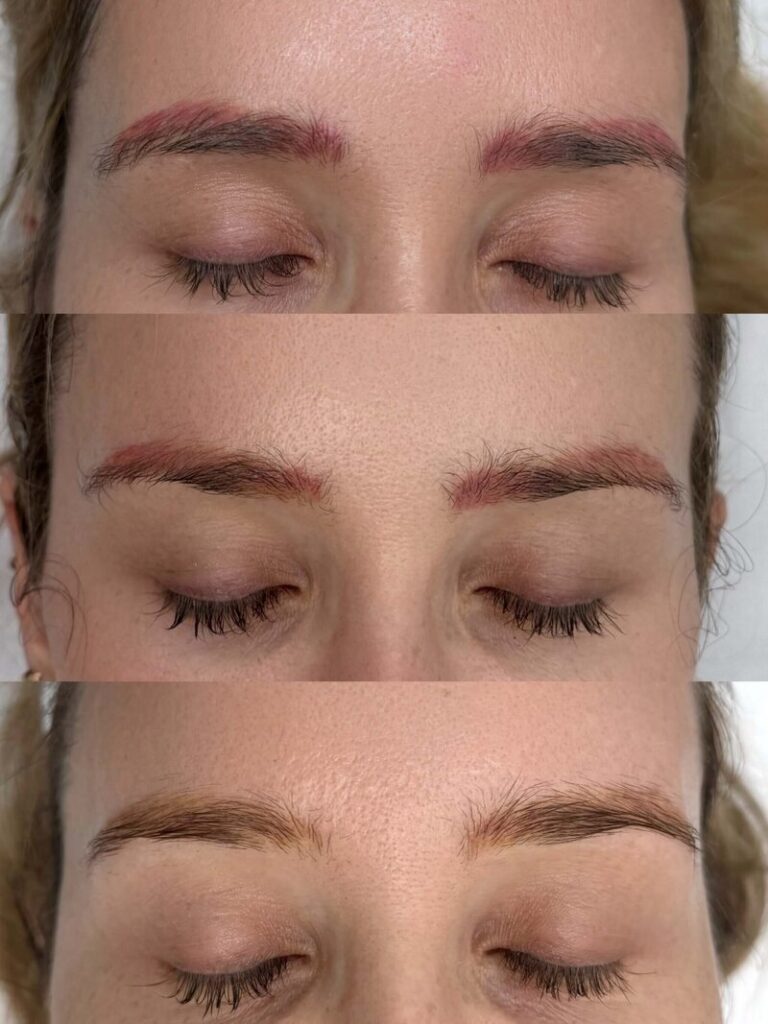
Eyebrow tattoo removal can temporarily reveal red, orange, or yellow pigment because permanent makeup “brown” is usually a mixture of several colorants rather than one brown ink. Laser eyebrow tattoo removal may clear the darkest component faster than the warmer components, exposing colors that were already present inside the original pigment blend. A red or orange eyebrow after treatment therefore does not automatically mean that the skin was burned or that the laser created a new pigment. Clinical reports have documented red, orange-red, and yellow shifts after laser treatment of cosmetic eyebrow tattoos.
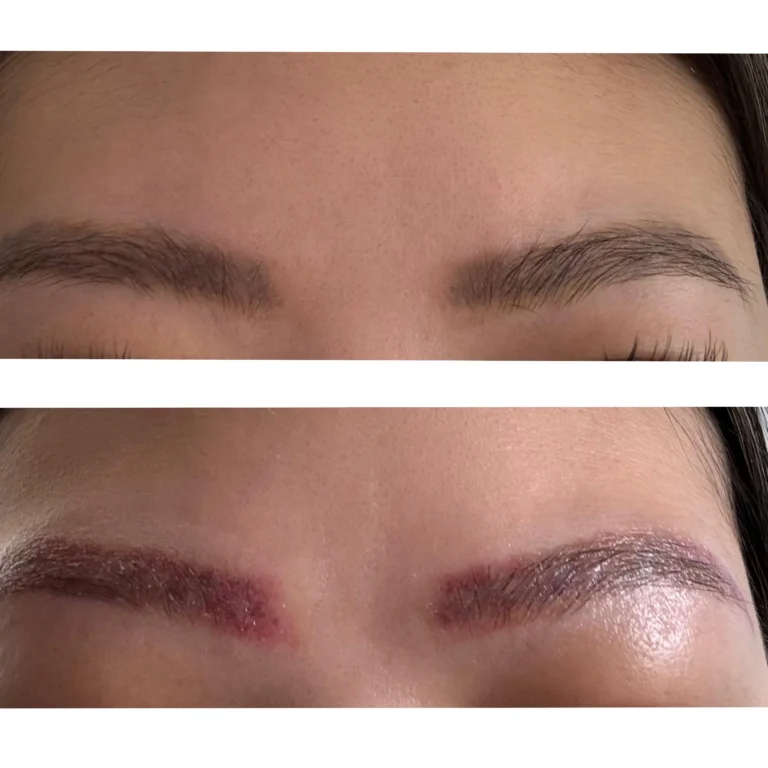
Laser eyebrow tattoo removal works selectively, so different components of the same PMU pigment can disappear at different rates. A dark brown eyebrow pigment may contain black, red, yellow, white, and other organic or inorganic colorants. When laser eyebrow tattoo removal reduces the darker component first, a previously hidden red, orange, peach, or yellow component can become visually dominant. The eyebrow did not necessarily “turn” into that pigment; laser eyebrow tattoo removal may simply have uncovered a color that was masked by darker material.
Laser eyebrow tattoo removal can also cause a true chemical color change, but that mechanism should not be confused with simple pigment unmasking. Cosmetic pigments containing iron oxides or titanium dioxide can behave unpredictably when exposed to short-pulse laser energy, and some light, flesh-toned, red, or white pigments can undergo paradoxical darkening rather than becoming lighter. Research has linked some cases to chemical changes in iron-containing pigments, although the exact chemistry is not completely understood.
Red or orange brows after eyebrow tattoo removal often appear because the darker portion of a brown pigment has been reduced before the warmer portion. A retrospective clinical series found red or orange-red changes in eight of ten patients who developed unusual lighter color shifts after laser treatment, supporting the idea that warm colors can become visible after the darker pigment is disrupted. The same study notes that the precise mechanism remains uncertain, so red or orange pigment should not automatically be labeled “oxidation.”
Red and orange pigment after eyebrow tattoo removal may respond to a different laser wavelength than the wavelength used for the original dark pigment. Dark tattoo pigment is commonly treated with wavelengths such as 1064 nm, while red and orange pigments can respond better to 532 nm energy because those colors absorb green light more efficiently. Published tattoo-removal literature supports 532 nm treatment for many red, orange, and red-brown pigments, but wavelength selection still depends on pigment composition, skin tone, previous treatment, and the equipment being used.
Yellow brows can appear during eyebrow tattoo removal when black and red components fade while a more resistant yellow component remains visible. In one clinical series, three patients developed yellow pigment after treatment of red or orange-red eyebrow tattoos with a 532 nm picosecond laser. Yellow therefore can represent another stage of pigment separation rather than a completely new pigment created by treatment.
Yellow pigment can make eyebrow tattoo removal less predictable because light-colored tattoo pigments generally absorb laser energy less efficiently than black pigment. Yellow may also be mixed with white, beige, red, or other modifiers, so two eyebrows that look equally yellow can contain very different pigment chemistry. A provider should therefore avoid promising that every yellow eyebrow can be cleared with one wavelength or a fixed number of sessions.
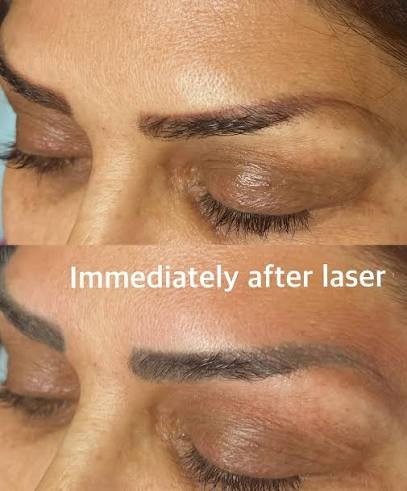
Paradoxical darkening during eyebrow tattoo removal is a separate reaction in which a light cosmetic pigment becomes darker after laser exposure. Permanent makeup containing iron oxide or titanium dioxide has been associated with this reaction, and classic reports describe cosmetic pigments becoming gray or black immediately after laser treatment. Paradoxical darkening is particularly important in PMU removal because skin-colored, pink, white, and light corrective pigments may be present even when the visible eyebrow looks brown.
A test spot can make eyebrow tattoo removal safer when the pigment history is unclear or a light corrective pigment may have been implanted. A client may know that the brows were microbladed or shaded but may not know the pigment brand, ingredients, previous color corrections, or number of layers in the skin. Because laser response cannot always be predicted from the visible color alone, published literature recommends test exposures when paradoxical darkening is a concern.
Previously corrected eyebrow tattoos can make eyebrow tattoo removal more complex because several generations of pigment may exist in the same skin. An old gray brow may have been covered with warm orange corrector, followed by another brown layer months or years later. Laser eyebrow tattoo removal can expose those layers sequentially, which means the eyebrow may appear brown, then red, then orange or yellow during different stages of treatment.
The original PMU technique alone does not reliably predict whether eyebrow tattoo removal will cause a color shift. Microblading, powder brows, ombré brows, and traditional cosmetic tattooing can all use blended pigments, and the retrospective eyebrow study found color changes in both microblading and traditionally tattooed eyebrows. Pigment chemistry, depth, saturation, age, previous corrections, and laser parameters may be more important than the technique name alone.
A red, orange, or yellow eyebrow does not automatically mean eyebrow tattoo removal failed, but a color shift should change the treatment strategy. Continuing to use exactly the same laser settings simply because the first treatment lightened the brow ignores the fact that the remaining pigment now has different optical properties. Effective eyebrow tattoo removal requires reassessment after healing and selection of the next treatment according to the color that remains.
Eyebrow tattoo removal should not be judged immediately after one laser session because pigment clearance continues after the appointment. Laser energy fragments susceptible tattoo particles, while the visible result develops gradually as inflammation settles and the body processes fragmented pigment. Immediate frosting, redness, swelling, or temporary darkening can also distort the apparent color, so the healed eyebrow provides more useful information for planning the next session.
Complete eyebrow tattoo removal cannot be guaranteed solely from the color visible at consultation. Some red and orange pigments respond very well to appropriate laser wavelengths, while yellow, white-containing, layered, or chemically altered pigments can require additional treatments or a different removal strategy. In the published eyebrow case series, 532 nm picosecond treatment produced substantial improvement in several red-orange cases, but the small sample size means those results should not be treated as a universal success rate.
Non-laser PMU removal can sometimes be considered when eyebrow tattoo removal reaches a pigment that is poorly suited to further laser treatment. Non-laser removal should not be presented as automatically superior to laser eyebrow tattoo removal, because the safest choice depends on pigment composition, skin condition, treatment history, and the provider’s technique. Claims that saline or other non-laser methods always prevent yellowing or reliably “pull pigment out” more safely than laser are stronger than the available evidence supports.
New permanent makeup should be planned only after eyebrow tattoo removal has reached a stable, healed endpoint. Placing another brown layer over unresolved red, orange, yellow, or darkened pigment can create a more complicated multi-layer problem for future correction. A PMU studio that understands both eyebrow tattoo removal and new brow design can decide whether complete removal is necessary or whether controlled fading is sufficient for a cleaner new shape.
Eyebrow tattoo removal at All Esthetics New York is planned around the actual pigment remaining in the skin rather than treating every brow with the same protocol. All Esthetics provides Pico laser eyebrow tattoo removal for old microblading, powder brows, ombré brows, unwanted permanent makeup, and brows that need fading before a new design. All Esthetics can also evaluate selected cases for CRC non-laser PMU removal when laser treatment is not the preferred next step.
All Esthetics approaches eyebrow tattoo removal from both sides of the PMU process: removing the unwanted pigment and planning what the brows should look like afterward. For clients who eventually want new microblading, powder brows, or another permanent makeup technique, the goal is not simply to keep firing a laser until the brows look lighter. The goal is to create a clean enough foundation for a safer, more predictable correction.
If eyebrow tattoo removal has already turned your brows red, orange, yellow, gray, or unusually dark, the next step should be an assessment rather than another automatic laser session. All Esthetics in Floral Park, New York can evaluate the existing pigment, previous PMU history, current color, skin response, and future brow goals before recommending the next stage of removal. A changing eyebrow color can be part of the removal process, but understanding why the color changed is what determines what should happen next.
Welcome to All Esthetics
10 Verbena Ave, Floral Park, NY 11001.
Sign up for Microshading, Microblading, Permanent Makeup Lips…