
Author: expert Ella
Instagram: @ella_permanentmakeup
21 years in the beauty industry. An expert in permanent makeup for Eyebrows, Lips, and Eyeliner.
Microblading for alopecia can recreate the appearance of eyebrow hair, but microblading cannot treat alopecia or make eyebrow hair grow back. Microblading places pigment into the skin in fine strokes designed to resemble individual brow hairs, which can restore shape and definition when alopecia has caused partial or complete eyebrow loss. The American Academy of Dermatology lists microblading as one cosmetic option for people who lose eyebrows from alopecia areata, while making clear that medical treatment and cosmetic camouflage serve different purposes.
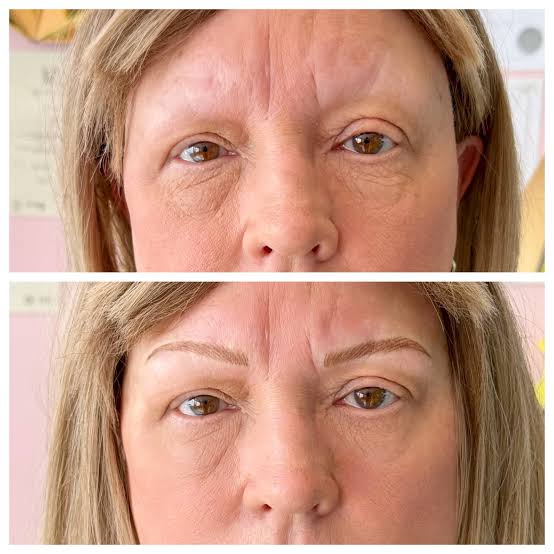
Microblading can replace the visual structure that disappears when eyebrow hair becomes sparse or missing. Microblading can fill isolated gaps, rebuild a shortened brow tail, correct uneven density, or create an entire eyebrow shape when little natural hair remains. Microblading usually looks most three-dimensional when some natural eyebrow hair remains because real hair adds texture and shadow that pigment alone cannot reproduce.
Microblading can significantly reduce the need to draw eyebrows every morning. Microblading creates a semi-permanent brow design that does not wash away like pencil or powder during normal daily activity. For someone who repeatedly recreates missing eyebrows with makeup, microblading can make the appearance of the brows more consistent, although microblading still requires future maintenance as pigment fades.
Microblading for alopecia can create convincing results even when eyebrow loss is extensive, but complete brow reconstruction requires more skill than filling a small patch. Microblading on a completely hairless brow leaves no natural hair to hide imperfect spacing, asymmetry, incorrect stroke direction, or poor color selection. Microblading for complete eyebrow loss therefore depends heavily on precise brow mapping, conservative shape design, pigment choice, and an artist experienced specifically with clients who have little or no eyebrow hair.
Microblading cannot stimulate follicles, stop an autoimmune process, or prevent additional eyebrow loss. Microblading changes the appearance of the skin rather than the biology of the hair follicle. Alopecia areata treatments may sometimes produce eyebrow regrowth, including dermatologist-directed therapies for appropriate patients, but microblading itself has no hair-regrowth mechanism.
Microblading cannot reproduce the physical texture of real eyebrow hair. Microblading can create the optical impression of individual hairs, but microblading remains pigment inside the skin rather than three-dimensional hair above the skin. Under very close inspection or strong directional light, a completely reconstructed eyebrow may therefore look different from an eyebrow containing natural hair.
Microblading cannot guarantee that an eyebrow design will remain equally suitable if the pattern of alopecia changes. Microblading is planned around the face and hair pattern that exist at the time of treatment, while alopecia may improve, recur, or change distribution. Microblading should therefore use a conservative shape that can still look natural if eyebrow hair later regrows in a slightly different pattern.
Microblading for partial alopecia is usually easier to blend naturally because existing eyebrow hair provides a reference for color, density, and stroke direction. Microblading can place individual strokes between surviving hairs so the pigment becomes part of an existing brow rather than creating the entire brow visually. For small patches of alopecia areata, microblading may therefore require less artificial density than microblading used for total eyebrow loss.
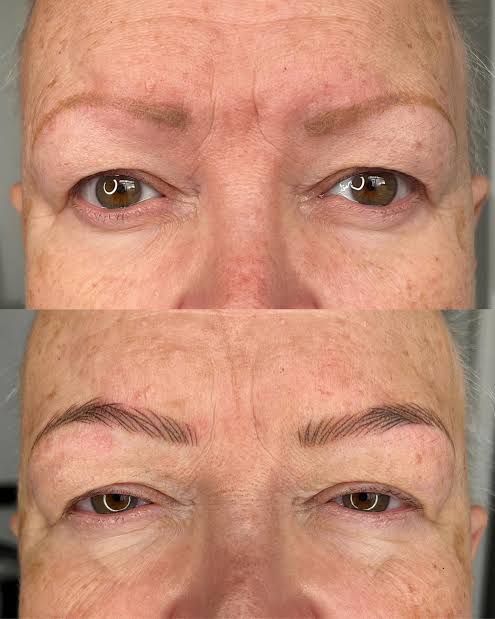
Microblading for complete eyebrow loss requires the artist to design a believable hair pattern from scratch. Microblading strokes should not simply run in identical parallel lines because natural eyebrow hairs change direction from the bulb through the arch and toward the tail. Microblading that ignores those changes can look drawn or stamped, while carefully varied stroke direction can produce a more convincing illusion.
Microblading for alopecia should not automatically be chosen simply because a client wants hair-like eyebrows. Traditional microblading creates strokes with a manual blade, while nano brows use a machine needle to create hair-like strokes and powder brows create controlled shading. The National Alopecia Areata Foundation notes that nano brows can provide a similar hair-stroke appearance with less skin trauma and may be preferable for some sensitive, thin, or oily skin types.
Nano brows may be a stronger PMU option than repeated microblading when a client has little or no natural eyebrow hair. Nano brows can create fine machine-made strokes without repeatedly cutting the skin with a manual microblading blade, and nano brow patterns can be useful when the entire eyebrow has to be visually reconstructed. Microblading can still be appropriate, but the technique should be selected according to skin characteristics and desired healed appearance rather than according to the popularity of the treatment.
Powder brows may be more predictable than microblading when the goal is a softly filled eyebrow instead of visible individual strokes. Powder brows use machine shading to create a makeup-like gradient and do not depend on each individual microblading stroke remaining sharply separated. Powder brows can therefore be considered for extensive eyebrow loss, oily or mature skin, or clients who already prefer the appearance of softly filled brows.
Microblading should be postponed when eyebrow loss is new, unexplained, rapidly changing, or associated with active skin symptoms. Microblading can conceal the visible loss, but microblading cannot identify why the loss is occurring. The American Academy of Dermatology recommends discussing microblading with a dermatologist first, and medical evaluation is particularly important when eyebrow loss is recent or the skin is inflamed.
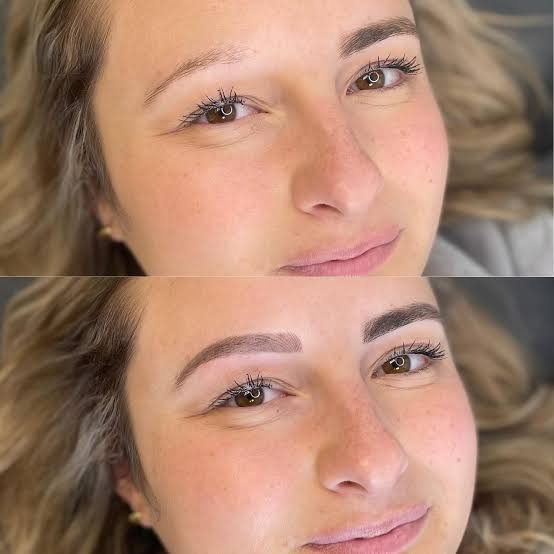
Microblading should not be performed over actively irritated, infected, broken, or poorly healed skin. Microblading breaks the skin barrier, which creates a genuine infection and healing risk rather than a purely cosmetic concern. FDA guidance on permanent makeup identifies infection, allergic reactions, granulomas, keloid formation, pigment migration, and difficult removal among recognized tattoo and permanent-makeup complications.
Microblading for alopecia should be treated as a fading cosmetic procedure rather than a permanent one-time eyebrow replacement. Microblading longevity varies substantially according to technique, skin, sun exposure, pigment, aftercare, and individual retention. The American Academy of Dermatology describes typical microblading longevity of roughly six months to one year, while the National Alopecia Areata Foundation notes that results may last around 18–24 months, which shows why a fixed promise such as “microblading lasts exactly two years” is not reliable.
Microblading also changes as the pigment fades, not simply by becoming lighter. Microblading strokes may gradually lose sharpness, pigment can migrate outside the intended placement, and color can change over time. FDA guidance specifically warns that permanent-makeup pigments can migrate or blur and that dissatisfied clients may find removal difficult.
Microblading for alopecia is only one option for replacing the appearance of missing eyebrows. PMU alternatives include nano brows, powder brows, and combination brows, while completely non-invasive alternatives include brow pencils, powders, temporary eyebrow transfers, and realistic eyebrow wigs. The National Alopecia Areata Foundation specifically identifies temporary brow transfers and brow wigs as options for people with little or no eyebrow hair, which makes permanent makeup a choice rather than a requirement.
Microblading may be the right choice when a client wants a low-maintenance hair-stroke effect and understands the limitations of pigment-based eyebrow reconstruction. Microblading is less suitable when the client expects permanent results, actual hair regrowth, guaranteed retention, or a perfect three-dimensional replacement for natural eyebrow hair. The best PMU consultation therefore begins with the desired visual outcome and skin suitability rather than with the assumption that microblading must be performed.
Eyebrow hair loss does not mean you have to draw your brows from scratch every morning. At All Esthetics in Floral Park, Long Island, we customize permanent makeup based on your skin type, remaining brow hair, facial features, and the result you want to achieve.
Choose the technique that fits your brows:
Microblading – ideal for creating fine, natural-looking hair strokes and filling sparse or uneven areas when you still have some natural brow hair.
Nano Brows – machine-created ultra-fine hair strokes designed for a soft, realistic look and often a better option when traditional microblading is not ideal for your skin.
Powder Brows – soft machine shading that creates fuller, more defined brows and can work especially well when eyebrow hair is very sparse or completely missing.
At All Esthetics, every brow procedure includes personalized brow mapping and pigment selection, so the goal is not to give every client the same eyebrow shape – it is to create brows that look balanced and natural on your face.
Not sure which PMU technique is right for your alopecia or eyebrow hair loss? Schedule a consultation at All Esthetics and let us help you choose between Microblading, Nano Brows, and Powder Brows based on your skin, existing brow hair, and desired result.
Microblading can be possible for people with alopecia when the brow skin is healthy and the procedure is medically appropriate. Microblading should first be discussed with a dermatologist when eyebrow loss is new, unexplained, actively changing, or associated with inflammation or another skin problem.
Microblading does not make eyebrow hair grow back because microblading creates pigment strokes rather than stimulating hair follicles. Microblading can make missing eyebrow hair less noticeable, while any treatment intended to restore hair growth must address the underlying cause of the alopecia.
Microblading can look natural without existing eyebrow hair, but microblading has less visual depth than a brow containing real hair. Microblading results depend heavily on brow mapping, stroke direction, pigment color, spacing, and the artist's experience reconstructing complete eyebrows.
Microblading and nano brows can both work for alopecia, but nano brows may be preferable for some clients with sensitive, thin, or oily skin. Nano brows use a machine needle rather than the manual blade used for traditional microblading, so the best technique should be selected after evaluating the skin and desired healed result.
Microblading longevity with alopecia varies rather than following one guaranteed timeline. Microblading may remain visible from months to well over a year depending on skin, technique, sun exposure, pigment retention, aftercare, and previous PMU, so maintenance should be planned according to the healed result rather than a fixed calendar.
Welcome to All Esthetics
10 Verbena Ave, Floral Park, NY 11001.
Sign up for Microshading, Microblading, Permanent Makeup Lips…