
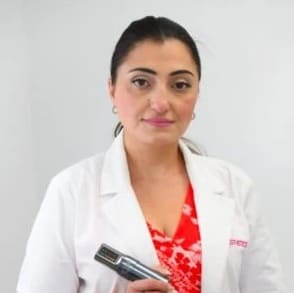
Author: expert Ella Pill
Instagram: @ella_permanentmakeup
21 years in the beauty industry. An expert in permanent makeup for Eyebrows, Lips, and Eyeliner.
If your eyebrows were done too dark, too wide, too gray, too red, uneven, or simply not you, laser removal can be the safest path toward a cleaner correction plan. The biggest fears most clients have are understandable: Will it leave scars? Does it hurt? Can laser treatment near the brows damage the eyes? Could I get burned? And what will my skin look like right after the procedure? The honest answer is this: when eyebrow tattoo removal is performed by a trained professional using appropriate settings and proper eye protection, the goal is to break up unwanted pigment while minimizing trauma to the skin. Temporary redness, swelling, tenderness, and sometimes mild blistering can happen during normal healing, but scarring and burns are not considered the expected outcome of a properly performed treatment.
For clients in New York, where appearance, recovery time, and safety all matter, it is important to understand that laser eyebrow removal is not just a cosmetic “quick fix.” It is a controlled treatment performed on delicate facial skin in a high-risk area close to the eyes. That is why choosing the right provider matters just as much as choosing the right treatment plan. Published reviews on periocular laser injuries show that eye complications are rare but real when safety protocols are ignored, and they are largely preventable when proper protection and correct technique are used.
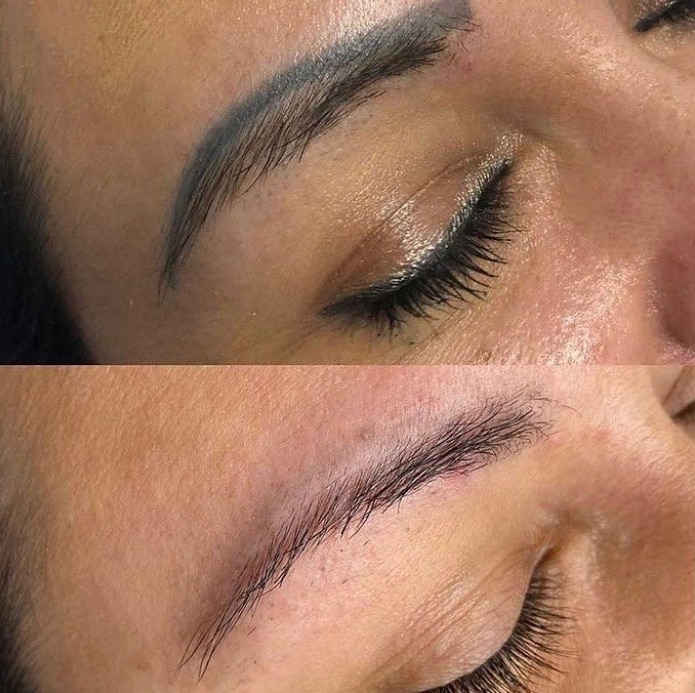
Eyebrow tattoo and microblading pigment sit in the skin in particles and layers. Laser energy targets those pigment particles and breaks them into smaller fragments, which are then gradually cleared by the body over time. That is one reason multiple sessions are usually needed: it is not safe or realistic to expect every layer of pigment to clear in one appointment, and the skin also needs time to recover between treatments.
This matters even more with bad eyebrow work because permanent makeup pigments can behave unpredictably. Some fade well. Others may shift in tone before they improve. A client may see an old eyebrow tattoo turn warmer, cooler, lighter, or patchier before it looks better. That does not always mean something went wrong. It often means the pigment composition and depth are revealing themselves in stages as the ink breaks apart.
This is usually the first question clients ask, and it deserves a direct answer: laser removal should not be designed to create scars. The goal is pigment reduction with the least possible injury to the skin. However, no ethical provider should promise a zero-risk procedure. If the skin has already been heavily traumatized by previous microblading, repeated cover-up work, aggressive chemical removal, infection, or poor aftercare, the risk profile changes. A scar may already exist before the first laser session even begins.
Scarring risk tends to be higher when the wrong settings are used, when skin is overheated, when a client has a history of abnormal scar formation, or when healing is disrupted by rubbing, picking, infection, or harsh products. The American Academy of Dermatology warns that laser procedures in inexperienced hands can lead to burns, permanent pigment changes, and scars. That is exactly why eyebrow removal is not a place to bargain-hunt or choose a provider based only on price.
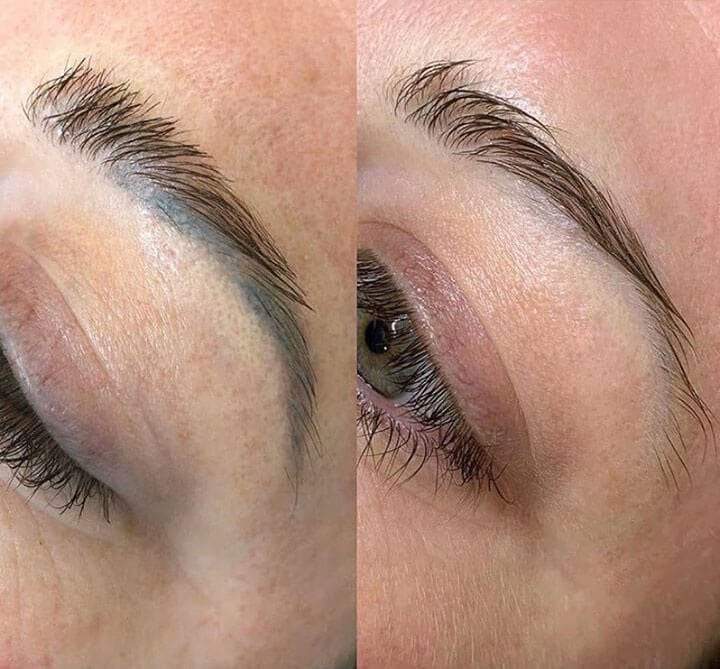
It is also important not to confuse temporary texture changes with true scarring. Right after treatment, the skin can look dry, puffy, tight, flaky, or uneven. That does not automatically mean scar tissue is forming. Early healing often looks more dramatic than the final result. True scarring is usually associated with more significant tissue injury, infection, or abnormal wound healing, not simple redness or post-treatment irritation.
Yes, it can be uncomfortable. Most clients describe it as a series of fast hot snaps, tiny electrical flicks, or short bursts of stinging heat. The good news is that the sensation is usually brief. Pain level varies based on your skin sensitivity, your personal pain tolerance, the type and density of pigment, and whether cooling or numbing support is used. The AAD notes that laser tattoo removal can be uncomfortable and may involve methods to reduce pain during treatment.
The eyebrow area is sensitive because the skin is thin and highly visible, but most clients find the procedure manageable when it is done efficiently and with a calm, experienced approach. What tends to make the experience feel worse is not always the laser itself. Anxiety, inflamed skin, recent skin treatments, lack of sleep, and unrealistic expectations can all make the procedure feel more intense.
A truthful way to explain it to clients is this: it is usually more intense than tweezing, shorter than a brow appointment, and more tolerable when you know what to expect. Overpromising a completely painless experience usually creates distrust. Honest providers explain comfort options, set realistic expectations, and move carefully through the treatment.
This is one of the most important sections of the article because the treatment area is very close to the eyes. Laser procedures around the brows and periocular area require serious safety standards. Medical literature documenting ocular injuries from cosmetic lasers makes one thing very clear: eye injuries can occur when lasers are used near the face without correct protection or proper technique. Reported complications have included corneal injury, retinal damage, conjunctival burns, and temporary or more serious visual symptoms depending on the device, wavelength, energy, and exposure pattern.
This is one of the most important sections of the article because the treatment area is very close to the eyes. Laser procedures around the brows and periocular area require serious safety standards. Medical literature documenting ocular injuries from cosmetic lasers makes one thing very clear: eye injuries can occur when lasers are used near the face without correct protection or proper technique. Reported complications have included corneal injury, retinal damage, conjunctival burns, and temporary or more serious visual symptoms depending on the device, wavelength, energy, and exposure pattern.
For a client, the practical takeaway is simple. If a provider is casual about eye protection, cannot clearly explain how they protect the eyes during brow removal, or treats the brow area as though it is no different from removing a tattoo on the arm, that is a red flag. Eyebrow laser removal should always be approached with extra caution because of how close the treatment sits to critical eye structures.
A burn is not something a client should be told to “expect.” Redness and swelling can be normal. A true thermal injury is a complication. Burns are more likely when the provider uses settings that are too aggressive, repeats excessive passes, ignores skin type, treats already irritated skin, or fails to manage heat appropriately. Reviews of cosmetic laser injuries have also noted that inadequate cooling between pulses can increase the chance of injury.
Clients can reduce risk by being honest during consultation. Tell your provider about recent peels, retinoids, sun exposure, skin sensitivity, medical conditions, active rashes, or anything that may impair healing. Do not show up with irritated skin and assume the treatment can “just be adjusted.” A skilled provider will assess whether the skin is ready, whether the pigment pattern makes sense for laser, and whether you need a different timeline or treatment sequence.
The provider’s skill matters, but so does the client’s decision-making. One of the most common causes of poor outcomes in aesthetic treatments is choosing a provider based on convenience, speed, or low pricing rather than training, case experience, and safety standards.
Most clients are surprised by the way the skin looks right after treatment because they are expecting a magical “before and after” moment. Real healing does not work like that. Immediately after laser eyebrow removal, the treated area may look pink or red, mildly swollen, warm, and more defined than usual. Some clients notice a temporary whitening or frosted appearance in parts of the treated skin. Tenderness is common. Mild blistering can also occur as part of the healing process after laser tattoo removal.
Within the first 24 hours, the brows may look puffier than expected. The skin can feel tight, sensitive, and dry. In some cases, small blisters or crusting may appear. Cleveland Clinic notes that swelling, blistering, and temporary skin-color changes can occur after laser tattoo removal, which is one reason spacing between sessions is necessary.
This is why clients should not judge the quality of the treatment by the first few hours alone. “Freshly treated” does not equal “final result.” In many cases, the area looks more inflamed before it begins to settle. Good providers explain this in advance so the client does not panic during normal healing.
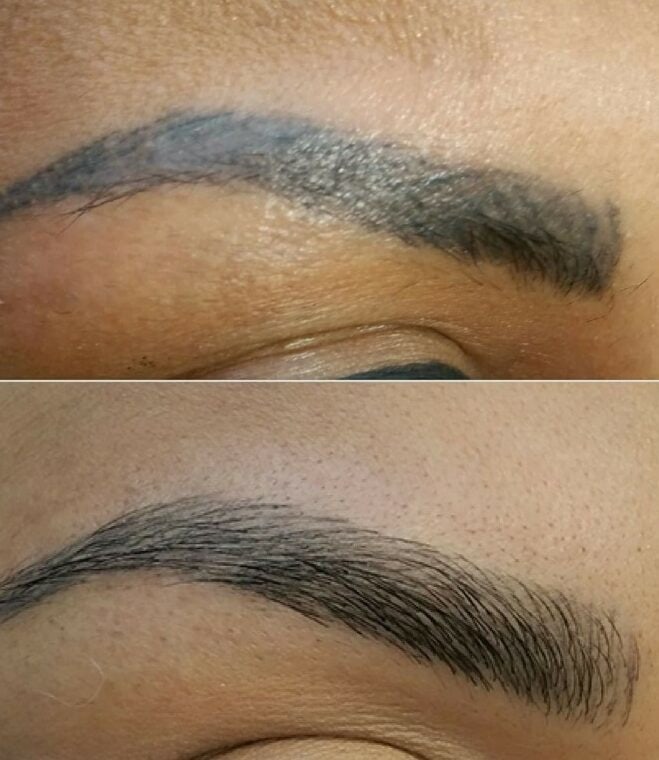
A lot of anxiety comes from not knowing what is expected. Mild redness, swelling, warmth, tenderness, dryness, and even some blistering can happen after laser tattoo removal. Those reactions are documented by major dermatology and medical sources.
What is not something to ignore includes worsening pain, spreading redness, drainage, signs of infection, severe blistering, increasing tissue damage, or any unusual eye symptoms such as vision changes, sharp eye pain, or persistent light sensitivity. Because eyebrow removal takes place close to the eyes, any concerning ocular symptom should be treated seriously. Reviews of periocular laser complications emphasize that eye injuries can be severe when they occur and should never be brushed off.
Healing is not just about the laser. It is about the full picture: the original brow work, pigment chemistry, how much trauma the skin already carries, your skin sensitivity, your immune response, sun habits, aftercare compliance, and provider technique. Some clients come in with old, shallow pigment and healthy skin. Others come in after multiple correction attempts, prior saline removal, inflammation, overworked skin, or long-term pigment migration. Those are very different cases and should not be treated as though they are identical.
That is why experienced providers avoid promising exact numbers of sessions, exact healing timelines, or guaranteed full removal on the first consultation. Ethical treatment planning is individualized.
Laser removal of bad eyebrows can be an incredibly valuable option for clients who feel stuck with microblading or permanent makeup that looks too dark, too cool, too warm, too heavy, or simply wrong for their face. The process can be uncomfortable, the skin can look inflamed right after treatment, and healing requires patience. But when the procedure is approached with proper technique, realistic expectations, careful aftercare, and serious eye protection, it can be a safe and effective step toward correction. Temporary redness, swelling, and even mild blistering may happen during normal recovery, while burns, eye injury, and scarring are risks that should be minimized through proper provider selection and safe treatment protocols.
Welcome to All Esthetics
10 Verbena Ave, Floral Park, NY 11001.
Sign up for Microshading, Microblading, Permanent Makeup Lips…